"[The] cause of suffering is something unskillful you’re doing, and the path to its end is something skillful you can learn to do."
Thanissaro Bhikkhu
"We are what we repeatedly do. Excellence then is not an act, but a habit"
Aristotle
Spiritual truth is not something elaborate and esoteric; it is, in fact, profound common sense.
Sogyal Rinpiche
Dear Friend,
Thank you for subscribing to the Self-Compassionate Living Newsletter! You can create and cultivate self-compassion by learning and practicing it. Engaging with a supportive community usually makes it easier. You signed up to receive this monthly newsletter as part of that effort. I will endeavor to inform and inspire you based on what I’ve learned from my personal experience. Please take the parts that aid your journey so that, hopefully, we can live happier, easier lives and explore together ways to treat ourselves better. Thank you for inviting me to join you on your journey! *
I have a glossary of many of the words and concepts related to self-compassion that I discuss in this newsletter, in my classes, and in my one-to-one coaching. You can find that glossary here: https://blairashby.com/glossary.html
This month, I’m building on the last several months' newsletters by tying together two critical issues of self-compassion: awareness and subtle little buggers. As I mentioned last month, “I’m continuing the discussion of awareness because I’ve found it to be the foundation on which all other self-compassion skills are built.” I’m adding to that statement a crucial dynamic of which to be aware: subtle little buggers. However, to avoid repeating what I have said so often in the past few months' newsletters, I’ll focus on Survival Modes to tie these two key components together.
Survival Modes are the built-in tools our Survival Brain uses to react to stimuli. Built-in means these are the tools that survival and biology gave us.
First: What are Survival Modes?
This is copied from my glossary on learning self-compassion and Communication:
The autopilot and usually subconscious reactionary process the Survival Mind uses to adapt to a physical advantage or threat, or perceived mental advantage or threat.
Positive and Negative reactions shift the brain into:
Fight Mode - A thought, emotion, or action that is aggressive or defensive toward a Trigger that is perceived as threatening.
Flight Mode - A thought, emotion, or action that tries to remove you from a Trigger that is perceived as threatening.
Freeze Mode - A thought, emotion, or action that tries to hide from or not draw attention to a Trigger that is perceived as threatening.
Grab Mode - A thought, emotion, or action that tries to acquire a Trigger that is perceived as an advantage.
Hold Mode - A thought, emotion, or action that tries to keep a Trigger that is perceived as an advantage for as long as possible.
Survival Modes are the automatic reactions our brains generate whenever a threat or benefit is perceived. If we are unaware of our brain doing this (which is usually the case), these thoughts generate feelings that compel us to take some form of physical/mental action to defend against them or to grasp them more. Usually, the actions are physical, like aggressive movements or facial expressions. Frequently, our mouths utter words to emphasize (and feed) the feeling. It is important to note, though, that sometimes the actions can be hidden; they are thought reactions and thinking patterns in our brains, not physical movements we act out.
No matter how we experience them, when we are unaware, they almost always cause us suffering. Thus, as we become more aware of these activations, we have a better opportunity to train ourselves to detach from emotional reactions, thereby minimizing our discomfort. (I realize that is a weighty statement I just made about detaching. I will address attachments and detachment from them in future newsletters or join my Self-Compassion Discussion & Inspiration Group or Self-Compassionate Living Refresher group to learn more.)
The way to move beyond Survival modes
Yes, you can move beyond Survival Modes controlling your life. Once you notice you’re reacting, the best method I’ve found to minimize my suffering is to pause. For an unpracticed mind, pausing before reacting seems impossible because we are usually raised to react and then think about the consequences afterward; reaction is usually a habit, in other words! The secret is to begin building a new habit of pausing, and the way to do that is to think about the trigger and then think about how you want to respond next time anything similar to the trigger arises. Plan to be the person you want to be because habitual reaction will probably make the decision for you next time you experience a similar trigger.
Remember the formula:
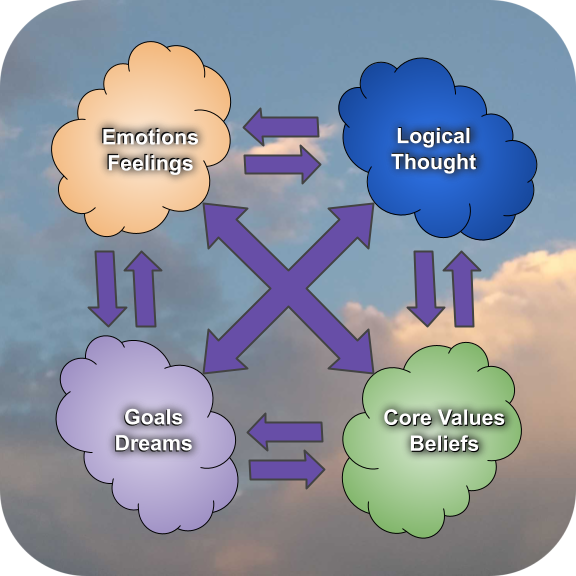
My thoughts genery feelings.
My feelings compel my actions.
My actions create my life.
Reaction is usually an automatic, autopilot habit. Response generally requires conscious thought. Thus, consciously plan to be the person you want to be when triggers occur. This means consciously going over past episodes where you felt unhappy with your reaction and then intentionally discovering and creating the action you want to take next time (please don’t harm yourself with this exercise. Start with small, non-traumatic reactions like feeling angry about the news and then build upon your strengths as you practice and improve).
Who do you really, Really, REALLY want to be?
Recall an experience you’ve had that you feel regret about your behavior. Now, think about pausing for one second and then imagine the way you wished you would have acted. Then repeat this mental exercise every day for a week. The reason you repeat this is that every time you think about the situation and the conscious response you want, your brain builds a memory of that thought pattern. After several mental practice sessions, when a similar trigger presents itself, your most recent memories will be of pausing and then behaving in a way that you want to behave.
This is training your brain in your daily life!
This mental exercise is a method for creating your life so that you are being the person that you really, Really, REALLY want to be.
I realize recalling minor tragedies that you regret may feel odd to remember because it probably isn’t your “normal” way of thinking. On the other hand, it’s your normal Survival Brain-based behavior that is normal because it’s the way you’ve always done it; it’s habitual. Therefore, this mental exercise is one way to build a new habit. It’s not normal because normal is our habit. By doing this mental exercise, you’ll create a new habit mentally—a new normal– and then you can live it in daily life more easily.
Life Costs Energy; Self-Compassion Costs Energy
I can imagine the section title sounds strange because the section above ends with “easily”. I titled this section this way because habits that take care of ourselves still cost us energy. Here’s the irony: survival doesn’t care about our life satisfaction; it’s just not part of the survival equation. Survival cares about us being not-dead, physically or mentally. Things that are normal work because in the past, doing the normal left us not-dead; they are a comfortable normal. However, notice I didn’t say normal mental and physical behaviors are effortless because they aren’t! Generally, habitual, normal behavior still requires a lot of energy.
In other words, life is going to cost energy no matter what! The Survival Brain wants to feel happiness; it grabs and tries to hold onto thoughts, feelings, and actions that feel happy or positive, immediately. Unfortunately, very quickly that same Survival Brain starts to feel worried that the positive feelings it generated won’t last, so it begins expending energy to hold onto them, and it can’t. Life is a process of ups and downs, and when we resist those changes, that resistance costs us energy.
Likewise, creating our lives to be meaningful and fulfilling also costs energy.
So, what do you want to invest in? Survival or thriving?
When we spend time in stillness, focusing on being present, we usually discover that we want meaning and satisfaction in our lives, not just temporary happiness. We also frequently discover that we are expending tremendous amounts of energy trying to maintain unsustainable happiness held together by dissatisfying thoughts we’ve unintentionally created from past experiences. Eventually, we realize that we are going to expend energy, no matter what.
I suggest that we expend energy creating self-compassionate processes. If you’re going to expend energy, isn’t it more meaningful to use it to practice self-compassion and build your life up?
A final inspiration… I hope.
Life is going to cost us energy no matter what; spending that energy on treating ourselves well mentally, emotionally, and physically directs that cost into creating a more satisfying life. Many might say this is common sense; what do you think?
Difficulties in life frequently come from the Survival-Brain’s resistance that arises when trying something new. Thus, consider moving into a self-compassionate practice slowly. Be gentle with yourself and gradually increase your self-compassionate activities so that you slowly teach your survival-mind that these new activities won’t harm you and will benefit you in fulfilling ways.
You’re worth being kind to. If you need to, learn the skill of self-compassion tenderly as you teach your Survival Brain a new skill, and it learns to value that skill for the meaning it creates in your life, not just the temporary happiness it generates from feeling pleasure.
Next Month
I suspect I will write about Attachments and Expectations next month…
If you have a particular topic you’d like to see discussed, please reply and suggest it to me.
On a Personal Note:
Every time I finish teaching my Creating Self-Compassion class, participants always ask me, “What’s next?” For many years, I didn’t have a satisfying answer. A few months ago, I started pondering a Self-Compassion Refresher class. Not a series of classes, though. Instead, one-off classes, each focused on an individual aspect of the Self-Compassion journey. I’ve decided to test this idea during August of 2026. On August 1, 15, and 29, I’m going to offer a Self-Compassion Refresher class. In each class, we’ll do a ten-minute time of centering, and then I’ll teach for about an hour on one aspect of the self-compassion journey. During the teaching, the floor is open to discussion, questions, and responses.
Let’s learn together!
When you read this, the first class will have happened; that was intentional; I decided to advertise the first class only to people who have signed up for the Self-Compassion Discussion & Inspiration Group announcements. The next class is on the 15th, and I am inviting everyone on my newsletter mailing list. These Refreshers are free; I’ll make a donation link available during the class, though, if you feel moved to offer some support.
Self-Compassion Discussion & Inspiration Group
2 or 3 days before each discussion group, I send a notification for the upcoming meeting. I want to respect your privacy, so I will not send you notifications about upcoming discussion group meetings unless you ask to be notified. If you would like to be reminded about the biweekly Self-Compassion Discussion & Inspiration Group meetings, please write to me here and ask me to add your name to the notification list. This reminder notification list does not sign you up to attend; it only notifies you of the next biweekly meeting.
The Self-Compassion Discussion & Inspiration Group has been deeply impactful for so many. Please join us for the next one on Saturday, August 8th,, from 10 to 11:30 AM MST.
The next two Self-Compassion Discussion & Inspiration Group meetings are scheduled for Saturday, August 8th, from 10:00 AM to 11:30 AM MST, and Saturday, August 22nd, from 10:00 AM to 11:30 AM MDT. Please join us.
Click this HYPERLINK "https://donate.stripe.com/8x2cMU60meyX4MYdUW3Nm06"link to visit the Self-CompassionateLiving.com webpage to learn more and to register.
These discussion groups are free!
On July 27th, I discovered that the link I’ve been providing for registering for this group doesn’t allow you to register without a donation. I am sorry for the confusion. If you want to attend the discussion group for free, please reply “Yes” to this email, and I will gladly add your name to the class invitation list. I’m working on fixing the registration process so you can register without donating. I don’t want financial reasons to prevent anyone from attending!
In each meeting, after a brief introduction, we observe 10 minutes of silent stillness, followed by a discussion of any self-compassion-related topics raised by participants. I may also spend about 10-15 minutes unpacking the themes that emerge in the discussion.
I humbly ask for a $10- $15 donation per session; however, all are welcome. No one will be turned away for financial reasons.
In Conclusion
By this point, you've probably realized that self-compassionate living is about building a new relationship with your brain, specifically by managing your mind to create your life rather than just reacting to it. Self-compassion begins with mind management, allowing you to live with greater joy, peace, and contentment (JPC) and experience fewer negative emotions. I have learned the information I share in these newsletters from spiritual teachers, philosophers, and psychologists during the last thirty-four years. I'm sharing it with you in the hope it helps you practice self-compassion. Please utilize the material that resonates with you and explore and learn about your mind. You can create the life that you want to live.
See you next month, and may the rest of this month be peaceful.
Thank you for inviting me to walk with you.
I believe in you!
Happy Holidays!
Blair
Blair@Self-CompassionateLiving.com
Self-CompassionateLiving.com
*I have made a glossary for many of the words I use in these newsletters, my classes, and coaching. You can find the glossary here: https://blairashby.com/glossary.html
PS: If you have any thoughts, comments, or questions, please reply to this email. Additionally, please share this email with those you care about. If you were forwarded this email and you want to receive it directly, please subscribe here: Subscribe to the Self-Compassionate Living Newsletter
Self-CompassionateLiving.com is committed to offering anyone, in any belief system, tools to help them reduce the suffering they experience and increase the Joy, Peace, and Contentment they feel. It’s about creating meaning for each moment by managing your mind, so you treat yourself with love and kindness.
All writing, videos, and photographs by Blair Ashby unless otherwise noted.
©2026 Blair Ashby. All rights reserved.